Japan Restarts World’s Largest Nuclear Plant: Is AI Worth the Risk?


I’ll be honest with you. When I saw the breaking news notification flash on my screen this morning, I didn’t just see a headline about energy policy. I felt a knot in my stomach.
I remember 2011 vividly. I remember sitting glued to the screen, watching the devastating aftermath of the Fukushima Daiichi disaster. Like many of you, I thought, “This is it. Humanity has learned its lesson. We are done playing with fire.”
For 15 years, that silence held. But today, the silence is broken.
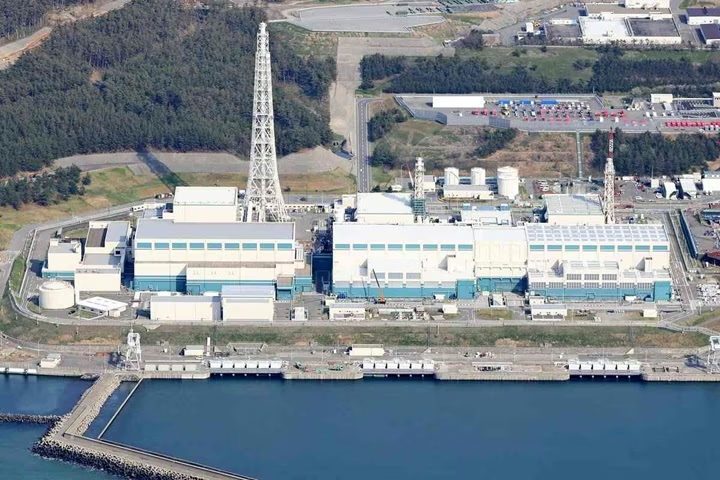
Japan is officially restarting the Kashiwazaki-Kariwa Nuclear Power Plant—the largest nuclear facility on the planet. While the mainstream media will tell you this is about “energy independence” or “economics,” as a technology analyst, I see a different, more alarming driver behind this decision: The insatiable hunger of Artificial Intelligence.
In this article, I’m going to take you behind the press releases. I want to explore why Japan is turning back to its most controversial energy source and what this tells us about the true cost of our digital future.
The Sleeping Giant Wakes Up
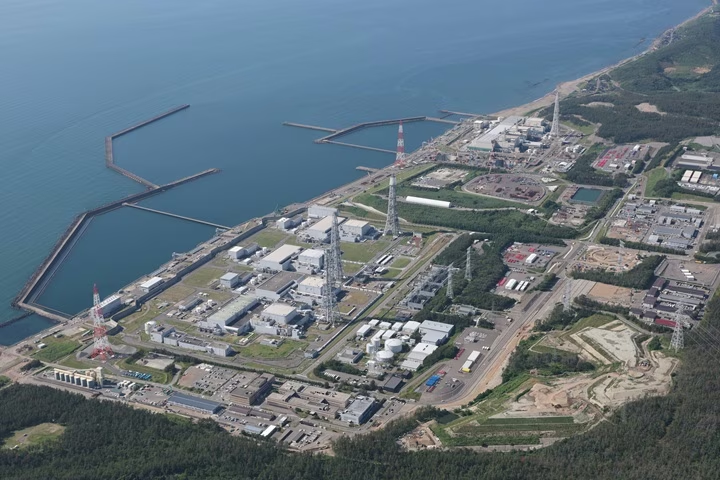
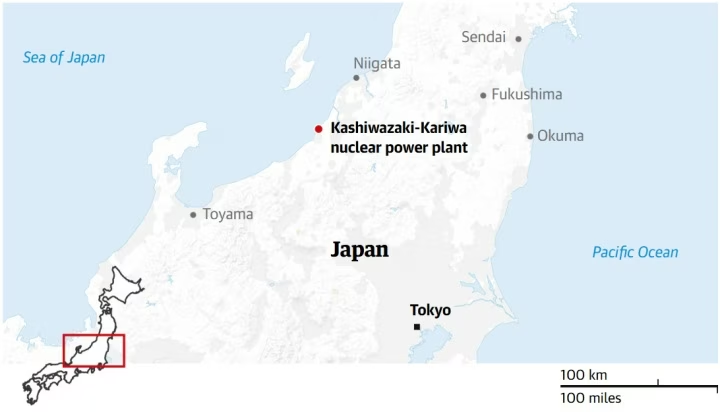
Let’s look at the facts first, because the scale of this is staggering. The Kashiwazaki-Kariwa plant isn’t just a power station; it’s a behemoth sitting on the coast of the Sea of Japan, about 220 kilometers from Tokyo.

TEPCO (Tokyo Electric Power Company) has officially begun the process of bringing Reactor No. 6 back to life. This isn’t a sudden flip of a switch; it’s a calculated, high-stakes procedure:
- Loading the Fuel: The control rods are being pulled. The reaction is starting.
- The 50% Threshold: Within a week, TEPCO plans to ramp the reactor up to half its capacity.
- The Safety Pause: Once they hit that mark, they will intentionally stop. They need to check the data, verify the cooling systems, and ensure history isn’t repeating itself.
- Full Commercial Power: If—and it’s a big “if”—regulators give the final green light, the reactor will go into full commercial operation by late February.
When all seven reactors are running, this facility pumps out 8.2 gigawatts of power. To put that in perspective, that’s enough to power millions of homes. Or, more relevant to our conversation, millions of high-performance GPUs.
The Hidden Culprit: Why Now?
Why is Japan, a country traumatized by nuclear disaster, doing this?
The government’s official line is about stabilizing energy supply and reducing reliance on imported LNG (Liquified Natural Gas). And yes, the numbers support that. Japan expects its LNG imports to drop by 4 million metric tons in 2026 because of this restart.
But here is my take, and it’s the part that worries me: Renewable energy cannot keep up with the Tech Giants.
We are living in the era of Generative AI. Every time we ask ChatGPT a question, every time we generate an image in Midjourney, and every time we simulate a world in the Metaverse, we are burning electricity.
The AI Energy Paradox
I love technology. You know I do. I spend my days exploring virtual worlds and testing new algorithms. But we have to face the uncomfortable truth: Data Centers are the new heavy industry.
- Consistency: Solar and wind are intermittent. AI training clusters need 24/7, uninterrupted baseload power.
- Volume: A single AI query can consume 10 times the electricity of a standard Google search.
- Urgency: The race for AGI (Artificial General Intelligence) is a sprint. Countries and companies don’t want to wait for battery technology to catch up. They need power now.
Japan aims to have nuclear power provide 20% of its electricity by 2040. Prime Minister Sanae Takaichi is pushing for this, and she’s even encouraging the development of next-gen Small Modular Reactors (SMRs).
To me, this signals a terrifying trade-off: We are accepting the risk of physical destruction to ensure our digital supremacy.
My Perspective: The Cost of “Smart”
As I researched this topic, I couldn’t help but feel a sense of irony.
We are building systems that are supposed to solve humanity’s biggest problems—curing diseases, optimizing logistics, fighting climate change. Yet, to power the “brains” that will save us, we are reviving the very technology that creates radioactive waste that lasts for thousands of years.
It feels like we are feeding a beast. The more capable our AI becomes, the more energy it demands. Today, it’s Reactor No. 6. Tomorrow, will it be Reactor No. 7? And then what?
Japan’s decision is a bellwether for the rest of the world. As AI adoption grows, I predict we will see more nations quietly walking back their “No Nuclear” promises. The digital world is expensive, and the currency is electricity.
Conclusion: A Question for the Future
I am not saying we should abandon AI. Nor am I saying nuclear power has no place in a carbon-free future. But restarting a massive facility in a seismically active zone like Japan, just 15 years after a meltdown, feels like a desperate move.
It forces us to ask a question that no one in Silicon Valley wants to answer:
Is the convenience of Artificial Intelligence worth the risk of another Fukushima?
I’m really curious to hear your thoughts on this. Are we making a necessary sacrifice for progress, or are we repeating the mistakes of the past? Let’s discuss in the comments.
You Might Also Like;